
How to Set Freelance Rates Without Underselling Yourself: A Step-by-Step Guide
Many freelancers undervalue their services—often earning less than they need to comfortably cover monthly expenses. For many, underpricing leads to stress, burnout, and an unpredictable income.
Setting your freelance rates can feel like balancing between losing clients and losing your financial stability. Charge too much, and prospects hesitate. Charge too little, and you end up overworked while earning far below your worth.
Your rates, however, are more than numbers—they communicate your expertise, your value, and the quality clients can expect. A thoughtful pricing strategy is essential for building a sustainable, profitable freelance business at any level.
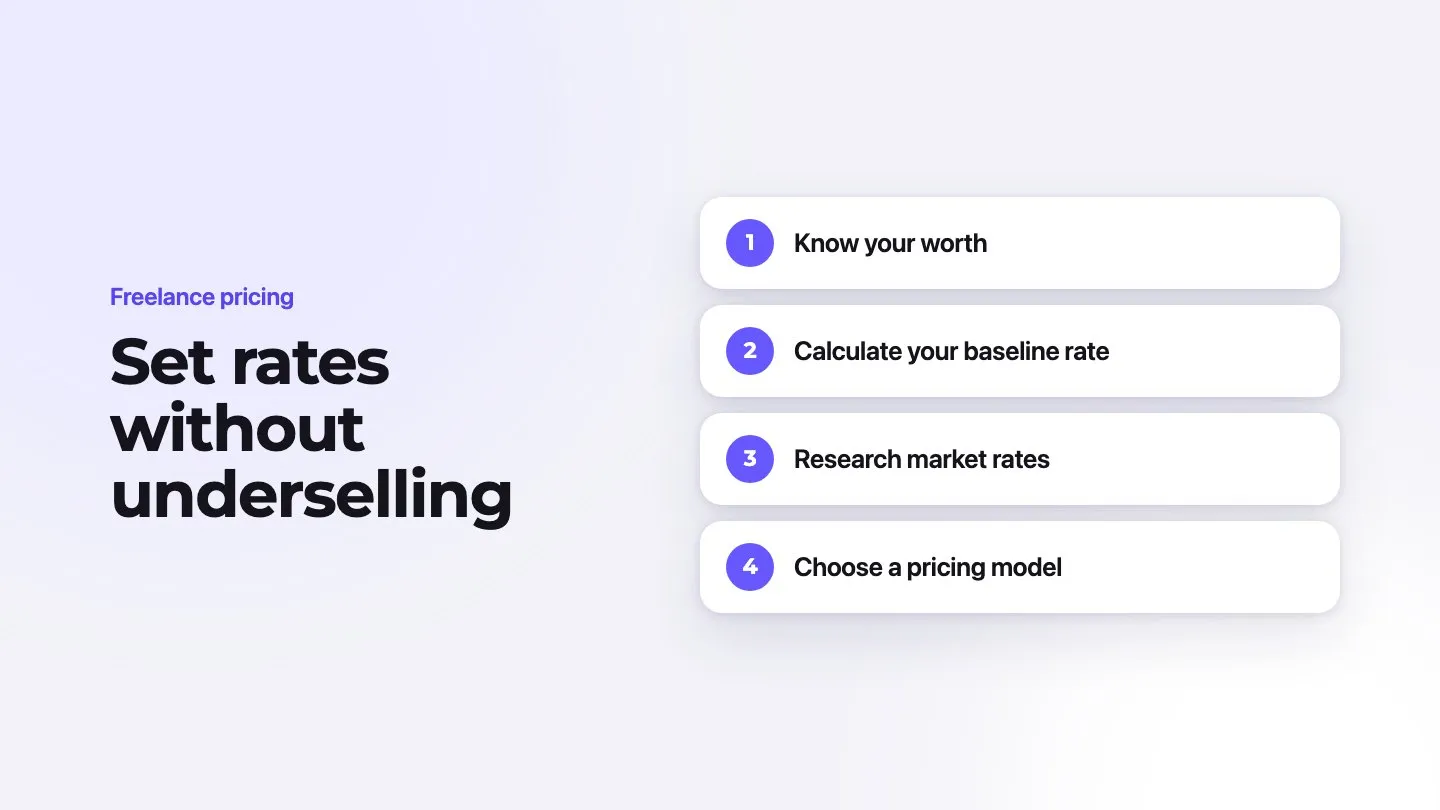
This guide walks you through how to set rates that reflect your real value—from calculating your costs to negotiating confidently.
Ready to stop undercharging and start earning what you’re worth? Let’s get started.
Understanding Your Worth as a Freelancer
Pricing yourself correctly starts with recognizing your value—not just your time. Many freelancers struggle with mindset barriers that lead to low rates.
Common mindset blocks around pricing
Pricing anxiety is one of the major obstacles freelancers face. Common mental blockers include:
- Fear that clients will choose cheaper competitors
- Self-doubt around one’s skill level
- Comparing rates to low-cost markets
- Believing you’re “too expensive”
- Discomfort asking for higher rates
The true cost of undercharging
Underpricing doesn’t just reduce income—it triggers a cycle of overworking, burnout, and lower-quality results. When you take too many low-paying projects, you lose the time you need for:
- Upskilling
- Marketing
- Business development
- Rest and recovery
This keeps freelancers stuck instead of growing.
Building pricing confidence
Confidence grows when you focus on outcomes rather than hours. Start documenting:
- Client wins
- Testimonials
- Successful projects
- Positive feedback
These become proof points that justify higher rates. Premium pricing naturally follows when your services solve valuable problems.
Calculating Your Baseline Rate
Once you understand your value, the next step is calculating a baseline rate that keeps your business healthy—not just afloat.
What you need to know about expenses
A clear view of your expenses is essential. Many freelancers forget hidden or irregular costs. Be sure to include:
Business expenses:
- Software and tools
- Insurance and licenses
- Marketing costs
- Education and training
- Equipment and maintenance
Personal expenses:
- Healthcare
- Retirement contributions
- Taxes
- Housing and living costs
Setting profit margins
Sustainable freelancing requires a margin above basic expenses, for example 20–30%, to leave room for growth.
The formula:
Monthly Expenses × 12 = Annual Expenses
Annual Expenses + (Annual Expenses × Profit Margin) = Target Annual Income
Target Annual Income ÷ Billable Hours = Minimum Hourly Rate
Only part of your working hours are billable—often somewhere around half to two-thirds once you count admin, marketing and learning—so base the calculation on realistic billable hours.
Making the most of rate calculators
Freelance rate calculators provide a helpful starting point, especially for catching hidden variables. When using them:
- Include every expense
- Use realistic billable hours
- Adjust for your experience level
- Consider your target market, not location
Your baseline rate should increase as your expertise and results grow.
Researching Market Rates in Your Industry
Now that you know your baseline, compare it to industry standards to position yourself confidently.
Finding reliable rate data
Useful sources include:
- Freelance platforms (e.g., Upwork)
- Industry reports
- Professional associations
- Networking and peer discussions
- Rate surveys
Industry-specific pricing trends
Rates differ enormously between fields and within them: a specialist developer and a generalist designer can be several times apart, and the gap between beginners and experts in the same field is just as wide. When you collect data, compare like with like:
| Compare | Why It Matters |
|---|---|
| Same service | “Design” covers logos, UX and print, each priced differently |
| Same experience level | Beginner and expert rates rarely overlap |
| Same client type | Startups, agencies and enterprises budget differently |
| Same pricing model | Hourly, project and retainer prices aren’t directly comparable |
Geographic rate variations
Your earning potential often depends more on your clients’ location and budgets than on your own. Freelancers worldwide can charge premium rates by focusing on high-value markets.
Structuring Your Pricing Models
Choosing the right pricing model helps you maximize revenue and clarity.
Hourly vs project-based pricing
Hourly pricing works best for unclear or evolving scopes—but punishes efficiency.
Project-based pricing rewards skill, speed, and clarity—ideal for well-defined deliverables.
Value-based pricing strategies
Value-based pricing ties your fees to the impact you create, not time spent. Steps:
- Understand client goals
- Estimate financial impact
- Set a price based on expected ROI
- Communicate the value clearly
Creating pricing tiers
| Tier | Features | Best For |
|---|---|---|
| Basic | Core deliverables | Budget clients |
| Standard | Core + extras | Most clients |
| Premium | Full service + priority support | Enterprise |
Tiers expand your customer base while boosting average order value.
Communicating Your Rates to Clients
Discussing rates shouldn’t feel confrontational when you focus on value.
Writing persuasive rate proposals
Powerful proposals include:
- Clear understanding of the project
- Value proposition
- Detailed deliverables
- Testimonials or case studies
- Multiple pricing options
- Terms and conditions
Handling price objections
| Objection | Response |
|---|---|
| “Too expensive” | Explain ROI and outcomes |
| “Others charge less” | Reinforce quality and expertise |
| “Not in our budget” | Offer adjusted package tiers |
Rate negotiation scripts
When clients hesitate:
“On similar projects, this work increased conversions by [X%]. Based on your current numbers, that could generate an additional $[amount] annually.” Only quote results you can back up with your own case studies.
For existing clients:
“Based on the strong results we’ve achieved and my increased expertise, my updated rate of [amount] will take effect on [date].”
Raising Your Rates Successfully
When to increase prices
| Scenario | What to Consider |
|---|---|
| Annual review | At least keep pace with inflation and rising costs |
| New skills | Price the added value, not the hours you spent learning |
| Market shifts | Recheck what comparable freelancers charge |
| High demand | A full calendar is a signal to raise rates |
| Industry pivot | Reset rates to the new market rather than carrying old ones over |
Notifying existing clients
Best practices:
- Give 60–90 days notice
- Personalize messages
- Justify the increase with value delivered
- Offer transition periods if needed
Managing rate transitions
Segment clients, set timelines, adjust service levels, and update all contracts and invoice templates.
A small amount of client turnover is normal—and often healthy.
Conclusion
Your pricing is one of the most strategic elements of your freelance business. Rates should reflect value, expertise, and the outcomes you consistently deliver.
Smart calculations, market research, strong communication, and regular price reviews form the foundation of profitable freelancing.
To simplify billing once your rates are set, try Invoxa: save your services with their rates, reuse them on estimates and invoices, and update them in one place when your prices change.
FAQs
Q1. How do I determine my baseline freelance rate?
Calculate annual expenses, add a profit margin, and divide by realistic billable hours.
Q2. What pricing model should I use?
Hourly for unclear scopes, project-based when deliverables are fixed, value-based for high-ROI services.
Q3. How often should I raise my rates?
Once or twice per year, depending on skill growth and market conditions.
Q4. How can I handle client objections?
Focus on ROI, outcomes, and value—not defending price.
Q5. What should I include in a rate proposal?
Clear scope, value proposition, deliverables, social proof, pricing options, and terms.