
How to Craft a Standout Freelance Portfolio: The Ultimate Guide
Many freelancers lose potential clients because their portfolios don’t make the right impression.
It’s a tough reality—talented freelancers miss out on dream projects simply because their freelance portfolios fail to stand out, and the market is more competitive than ever. Making your portfolio shine isn’t just a nice-to-have; it’s essential if you want to thrive, charge higher rates, and work with better clients.
This guide covers the factors that lead to that all-important “Hire Now” decision, and the common portfolio mistakes that quietly turn clients away.
Whether you’re building your first freelance portfolio or refreshing an existing one, this guide will show you how to present your work in a way that grabs attention, builds trust fast, and wins clients.
Ready to transform your portfolio from unnoticed to unforgettable? Let’s dive into practical strategies that will help you stand out and succeed.
Understanding Portfolio Psychology
The psychology behind successful freelance portfolios goes far beyond visual style – it’s about understanding how potential clients think, scan information, and make decisions under time pressure.
Usability research has found that people judge a web page’s visual appeal within about 50 milliseconds (Lindgaard and colleagues, 2006). That’s faster than a blink – which means every detail on the first screen they see matters.
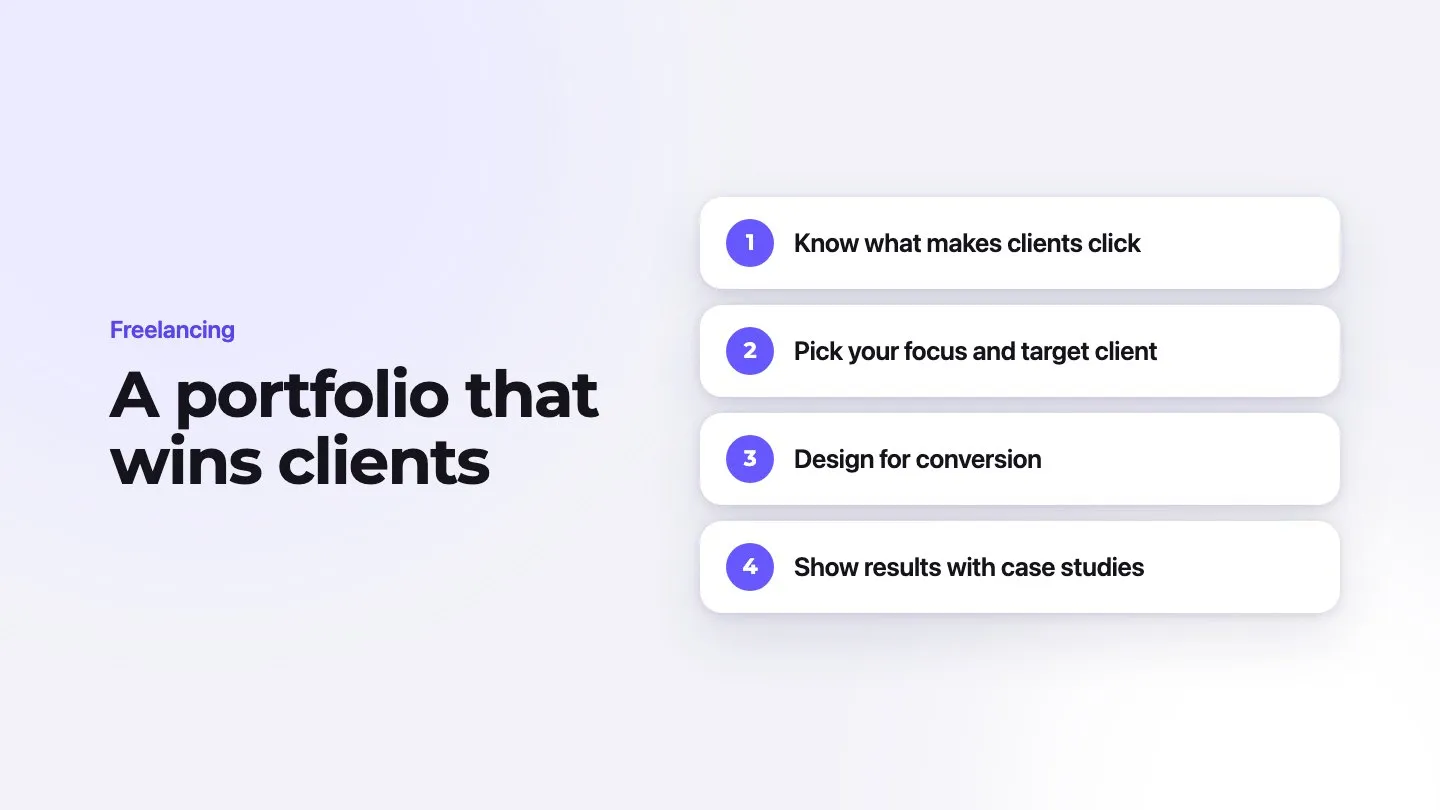
What Makes Clients Click
Three core psychological triggers determine whether clients explore a freelance portfolio or close the tab immediately:
- Visual Impact: A clean, professional design that signals competence and attention to detail.
- Clear Value Proposition: A quick, obvious explanation of what you do, who you serve, and how you help.
- Trust Signals: Social proof, testimonials, logos, and real case studies that reduce perceived risk.
High-performing freelance portfolio websites use these triggers deliberately. Your work should look impressive, but it also needs to be easy to process so decision-makers understand within seconds why you’re a strong fit.
Psychology Behind Portfolio Design
Portfolio design directly shapes how potential clients interpret your skills. Color psychology, layout, and typography all communicate subtle messages about your reliability and style.
For instance, blue tones tend to build trust and stability, while strategic accents of warmer colors (like orange or red) are great for drawing attention to key buttons and calls-to-action.
Eye-tracking studies show that visitors rarely read portfolios line by line. Instead, they scan pages in predictable patterns. On content-heavy pages they tend to follow an F-pattern; on landing-style pages, a Z-pattern is more common. Smart portfolio design uses headings, spacing, and visuals that guide the eye naturally through your most important messages.
Building Trust Through Visual Hierarchy
Visual hierarchy does more than make your freelance portfolio look good – it quietly guides clients through your story and builds trust step by step.
Clients stay longer on portfolios they can take in at a glance. Size, color, contrast, and spacing all work together to create that hierarchy:
- Your strongest work samples and most impressive outcomes are positioned and styled to stand out.
- Secondary information like project context and process sits below, easy to find but not overwhelming.
- Supportive elements such as testimonials, client logos, and metrics are used to reinforce key points.
Your freelance portfolio isn’t just a gallery – it’s a psychological tool that can build or break trust in seconds. Understanding these principles lets you design a layout that both showcases your work and connects with how clients actually make decisions.
Crafting Your Portfolio Strategy
A winning freelance portfolio doesn’t happen by accident. Behind every “lucky” freelancer with constant inquiries there’s usually a clear strategy that shapes what they show, how they show it, and who they’re speaking to.
Defining Your Target Client Avatar
The first step in building a high-converting freelance portfolio is defining your ideal client before you touch design or layout. Portfolios are most effective when they feel like they were built for one specific type of client.
Start by outlining your client avatar with details like:
- Industry, business model, and company size
- Typical budget range and project duration
- Primary pain points and business challenges
- How they measure success (KPIs, metrics, outcomes)
- Decision-making style and communication preferences
When you’re clear on who you want to attract, you can make better decisions about which work samples to feature, what language to use, and which results to highlight in your freelance portfolio.
Choosing Your Portfolio Focus
Once you know your ideal client, you can choose a clear focus for your portfolio. A common mistake is trying to appeal to everyone – different industries, styles, and price points – which usually leads to weak positioning.
Your freelance portfolio focus should act like a spotlight. It highlights projects that are:
- Directly relevant to the type of client you want more of
- Profitable and enjoyable for you to work on
- Strong demonstrations of your signature strengths
For example, if you want to work with tech startups, a portfolio full of corporate brochure designs will feel off-target. Clients quickly judge whether you “get” their world based on the first few projects they see.
Creating Your Portfolio Roadmap
With your target client and focus defined, you can create a practical roadmap to build or upgrade your freelance portfolio. Think of it as a bridge between where you are now and the opportunities you want to attract.
A strong portfolio roadmap typically includes:
- An honest audit of your existing work – what stays, what goes, and what needs updating
- A list of gaps where you need new or improved portfolio pieces
- A plan to create missing work (e.g., personal projects, collaborations, or repositioning past work)
- A timeline for rewriting copy, refining visuals, and publishing updates
Working in 90-day sprints keeps the process manageable and flexible. Each sprint can focus on a small set of improvements, such as adding two strong case studies or redesigning your portfolio homepage.
This strategic approach turns your freelance portfolio into an intentional client-attraction tool instead of a random collection of past work.
Designing for Conversion
The primary job of your freelance portfolio is not just to impress visitors – it’s to convert the right visitors into leads and clients. That means design decisions should be driven by conversion, not only aesthetics.
High-Converting Portfolio Layouts
The most effective portfolio layouts guide potential clients through a clear, logical journey. Effective portfolio websites usually include these elements:
- A concise, outcome-focused value proposition visible above the fold
- Immediate access to your strongest projects or featured case studies
- Short credibility-building section (testimonials, logos, credentials)
- Clear navigation to services, pricing info, or FAQs
- Prominent contact or “Work With Me” section
Minimalist layouts with plenty of whitespace tend to convert better because they reduce noise and cognitive load. The easier your portfolio is to scan, the more likely clients are to explore your work in depth.
Call-to-Action Optimization
Even the best freelance portfolio fails if visitors don’t know what to do next. Strategic calls-to-action (CTAs) throughout your site can significantly increase the number of inquiries.
Effective CTA optimization relies on three factors:
- Placement: Your primary CTA (like “Start Your Project” or “Book a Call”) should be visible without scrolling and repeated at logical decision points.
- Design: Buttons should use contrasting colors and sufficient spacing to stand out from the rest of the page.
- Copy: Action-oriented, specific language (“Get a Free Project Quote”) beats generic “Contact Me” labels.
Experimenting with different CTA variations can reveal what your audience responds to best.
User Experience Best Practices
A smooth user experience (UX) is essential if you want potential clients to stay, explore, and eventually contact you. Friction in the browsing experience leads directly to lost opportunities.
Focus on these UX fundamentals:
- Mobile responsiveness: Many clients will first open your portfolio on a phone, so your layout, images, and buttons need to work on all screen sizes.
- Simple navigation: Visitors should find key sections – Work, About, Services, Contact – in one or two clicks.
- Fast loading speed: Compress images and avoid heavy scripts. Slow pages lose visitors before they see your best work.
When your freelance portfolio feels fast, clear, and easy to use, clients subconsciously assume working with you will be the same.
Showcasing Work Effectively
Showing your work is more than uploading screenshots or links. The strongest freelance portfolios turn each project into a mini sales story that shows how you solve real problems and deliver measurable results.
Case Study Framework
Well-structured case studies are one of the most powerful assets in a freelance portfolio. They let clients see how you think, not just what the final output looks like.
Use this simple framework for each case study:
- Client & context: Who the client is and what situation they were in.
- Problem statement: The core challenge or goal, stated in clear, business-focused language.
- Strategy & approach: How you analyzed the situation and what plan you proposed.
- Execution: Key steps, deliverables, and decisions you made along the way.
- Results: Concrete outcomes like metrics, time saved, revenue generated, or qualitative feedback.
- Testimonial: A short client quote that reinforces the impact of your work.
Place your strongest case study near the top of your freelance portfolio homepage or Work page. First impressions matter, and one excellent project can outweigh several average ones.
Project Result Visualization
Visuals dramatically increase how quickly and clearly clients grasp your impact. Rather than only listing numbers in paragraphs, turn results into simple visuals when possible.
| Visualization Type | Best Used For | Impact |
|---|---|---|
| Before/After Images | Branding, design, UX, content revamps | Instant side-by-side comparison |
| Progress Charts | Traffic growth, conversion lift, engagement | Data-driven credibility |
| Impact Infographics | Complex results or multi-step projects | Easy understanding at a glance |
Portfolios that combine strong copy with clear visuals tend to receive more inquiries than those that rely on text alone.
Portfolio Storytelling Techniques
The best portfolio pieces don’t just show what you did – they tell a story that lets potential clients imagine working with you. Effective storytelling makes your freelance portfolio memorable.
Focus on three storytelling pillars:
- Context: Briefly describe where the client started and what was at stake.
- Conflict: Highlight the obstacles or constraints that made the project challenging.
- Resolution: Show how your solution changed the situation and what happened afterward.
Sprinkling short client quotes throughout the story – rather than collecting them in one long testimonial section – reinforces credibility at key moments.
Remember: your portfolio should demonstrate your thinking process and problem-solving skills, not just the final visual result.
Optimizing for Different Platforms
Your main website is only one part of your online presence. In today’s market, a strong multi-platform strategy helps your freelance portfolio reach more of the right clients.
Platform-Specific Portfolio Tips
Each platform has its own strengths, audience expectations, and content formats. Simply copying the same portfolio everywhere usually leads to weak performance.
| Platform | Key Optimization Focus | Content Priority |
|---|---|---|
| Personal Website | Deep-dive presentation | Full case studies and service details |
| Professional positioning | Experience, achievements, recommendations | |
| Behance/Dribbble | Visual impact | Polished visuals and selected highlights |
| Personal brand | Process shots, behind-the-scenes, outcomes |
Your branding – colors, tone of voice, and key messages – should stay consistent, while the way you package projects adapts to each platform.
Multi-Platform Portfolio Strategy
Instead of treating every platform as a separate portfolio, think of them as parts of one ecosystem working together to attract clients.
A solid multi-platform strategy often includes:
- A personal website as the central hub for your full freelance portfolio
- LinkedIn optimized for credibility, thought leadership, and B2B discovery
- Creative platforms (Behance, Dribbble, GitHub, etc.) used as proof of craft
- Social channels to humanize your brand and show your process
- Clear cross-links between platforms so clients can easily move from one to another
This approach makes it easier for different types of decision-makers to discover you in the environment where they’re already active.
Cross-Platform Analytics
Tracking performance across platforms lets you double down on what works and avoid wasting time on what doesn’t.
Key metrics to monitor include:
- Which platforms send the most visitors to your main freelance portfolio website
- Engagement metrics such as saves, shares, and comments on portfolio posts
- Which posts or case studies lead directly to inquiries or discovery calls
Patterns in the data will show you which platforms deserve more focus and which portfolio pieces resonate most with high-value clients.
Measuring Portfolio Success
A beautiful portfolio is only truly successful if it consistently brings in leads and projects you want. Measuring performance gives you the insight you need to keep improving your freelance portfolio over time.
Key Performance Metrics
These metrics provide a clear picture of how well your portfolio is doing its job:
| Metric | What It Measures | What to Look For |
|---|---|---|
| Bounce Rate | How many visitors leave after viewing one page | Falling after you improve the first screen |
| Average Time on Site | How long visitors stay engaged | Longer visits on case study pages |
| Pages per Visit | How deeply people explore your portfolio | Visitors moving from Work to Contact |
| Conversion Rate | Percentage of visitors who contact you | Rising as you refine CTAs |
| Returning Visitors | How often people come back | Prospects returning before they get in touch |
Benchmarks vary widely by field and traffic source, so compare your portfolio with its own past numbers. Tracking them monthly helps you spot trends and see which updates improve performance.
A/B Testing Your Portfolio
A/B testing – running two versions of a page or element to see which performs better – is one of the most reliable ways to improve your freelance portfolio over time.
Useful elements to test include:
- Headline wording on your homepage or Work page
- CTA button text and placement
- Order and selection of featured projects
- Length and structure of your case studies
- Contact form fields and layout
Run each test long enough to collect meaningful data, then keep the higher-performing variation. Over time, small improvements stack into big gains.
Conversion Rate Optimization
Conversion rate optimization (CRO) is the ongoing process of making your portfolio better at turning visitors into leads. It’s not a one-time project; it’s a habit.
Some high-impact CRO ideas for freelance portfolios include:
- Adding quick “Project Summary” blocks above detailed case studies for busy visitors
- Including a short FAQ section to remove common objections
- Using simple trust badges (years of experience, number of projects, media features)
- Making it easy to book a short introductory call directly from your site
Tools like analytics dashboards and simple tracking systems show you exactly where people drop off and where they convert, so you can focus your efforts where they will have the most impact.
Conclusion
A standout freelance portfolio is the engine of a successful solo business. When you combine psychology, clear strategy, thoughtful design, and real data, your portfolio becomes more than a gallery – it turns into a reliable client acquisition system.
Effective portfolios don’t just show pretty work. They tell clear stories, highlight measurable results, and speak directly to the clients you want to attract. They also evolve over time as you gather feedback, track performance, and refine your positioning.
While your portfolio brings in new opportunities, you also need professional systems for working with clients. With invoice maker Invoxa, your estimates and invoices carry your logo and brand color, so they look as polished as your portfolio, and clients can pay online by card, Apple Pay or Google Pay.
Let data and real-world behavior guide your decisions. Update your freelance portfolio regularly, track what works, and remove what doesn’t. With a confident, well-structured portfolio and solid back-end processes, you’ll be ready to stand out in a crowded market and consistently win better projects.
FAQs
Q1. How do I choose which projects to include in my freelance portfolio?
Select 5–10 of your strongest and most relevant projects that showcase the type of work you want more of. Prioritize pieces that produced clear results and align with your target clients’ industries and problems.
Q2. What information should I include with each portfolio piece?
Include a short overview of the client, their challenge, your role, and the solution you delivered. Add visuals, list key responsibilities, and highlight measurable results whenever possible. This turns each project into a mini case study.
Q3. How often should I update my freelance portfolio?
Review your portfolio every few months. Add new high-quality work, remove outdated or less relevant pieces, and refine your copy based on the clients you’re currently targeting.
Q4. Should I include client testimonials in my portfolio?
Yes. Genuine testimonials are powerful trust signals. Place short quotes near relevant case studies or on your homepage so visitors see social proof at key decision points.
Q5. How can I make my freelance portfolio stand out?
Focus on clarity and outcomes. Tell concise stories around each project, show your process, and emphasize the results you helped clients achieve. Combine this with a conversion-focused layout, strong CTAs, and consistent branding across platforms, and your freelance portfolio will stand out in a crowded market.