
VAT Invoice: What It Must Include and How to Get It Right
It’s surprising how many businesses overlook the power of proper VAT invoicing. A missing VAT number or a wrong rate can cost your customer their input VAT and cost you time, penalties and goodwill.
Talking about VAT isn’t exciting. Yet with more than 170 countries operating a VAT or GST, mastering these documents matters for any business that sells across borders. Successful VAT management doesn’t happen by chance—it comes from understanding the rules and implementing smart systems.
VAT invoices need precise timing and careful attention to detail. This guide uses UK and EU rules as its main examples. Whether you’re a seasoned business owner or just getting started, you can learn how to turn VAT compliance from a burden into a business advantage.
Ready to stop losing money through improper VAT handling and start building a more profitable business? Let’s dive into proven strategies that will help you master VAT invoicing and protect your bottom line.
The Basics of VAT Invoicing
What is VAT invoice?
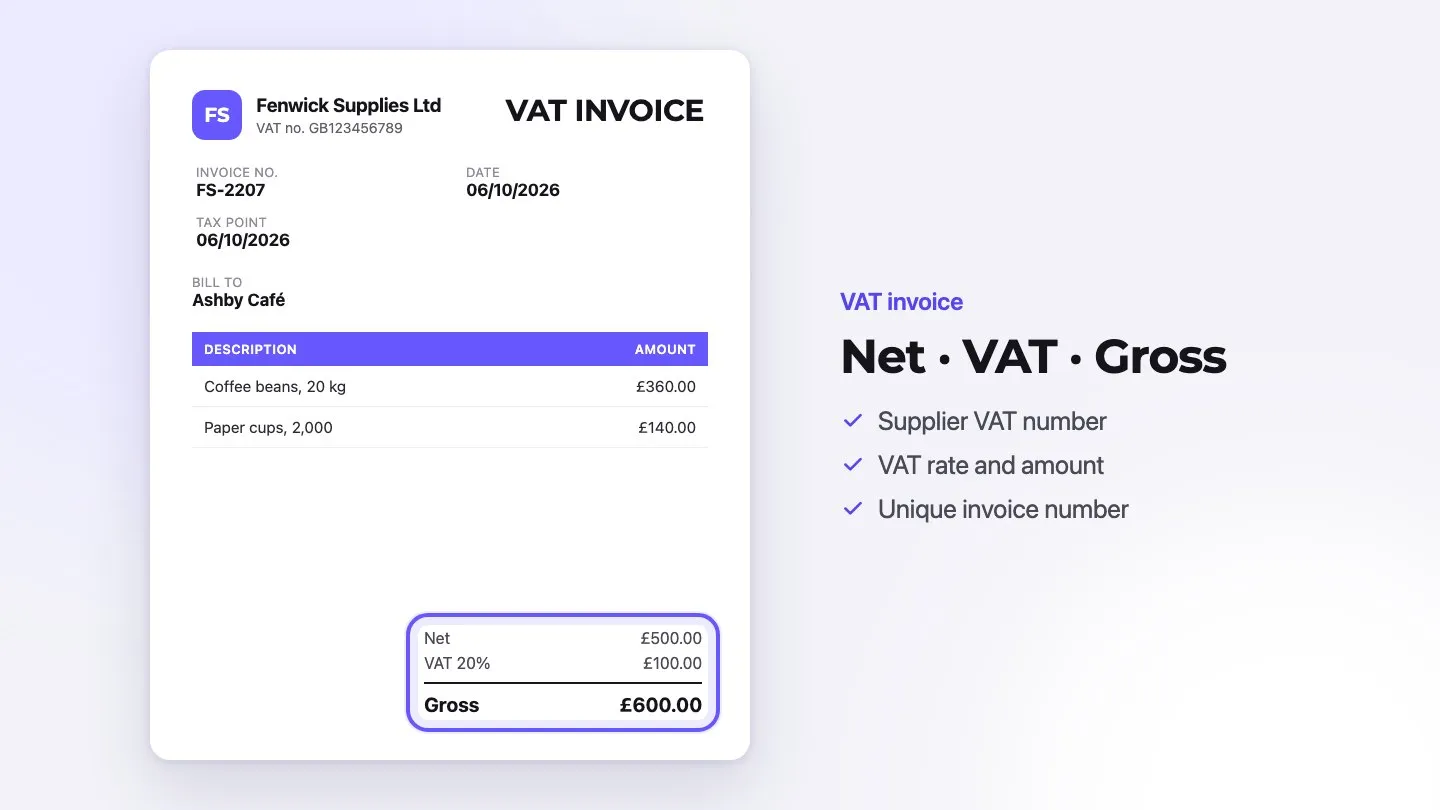
A VAT invoice is an official document businesses issue when selling goods or services subject to Value Added Tax (VAT). It’s more than just a receipt—it serves as proof of a taxable transaction and ensures both the seller and buyer can properly account for VAT. This invoice includes important details like the seller’s business name, address, and VAT registration number, as well as the buyer’s details if necessary. It also specifies the invoice date, a unique reference number, a description of the goods or services provided, the VAT rate applied, the net price before tax, the VAT amount charged, and the total amount payable. One key advantage of a VAT invoice is that it allows businesses to reclaim input VAT, reducing their overall tax burden. While the United States doesn’t have VAT, companies that trade internationally often deal with VAT invoices to comply with tax laws in other countries. Keeping accurate VAT invoices helps businesses avoid penalties and maintain proper financial records.
A VAT (value-added tax) invoice is a specific type of documentation that businesses use to detail the VAT charged on sales and the VAT paid on purchases. It includes the VAT amount, the VAT rate applied, and other mandatory details that facilitate accurate tax reporting and compliance. Value matters more than paperwork - yet VAT invoices need both precision and purpose. Successful VAT management starts with understanding what makes these documents unique and knowing exactly when you need them.
What makes it different
VAT invoices serve as official tax documents, setting them apart from standard bills. Proper VAT documentation needs specific elements standard invoices don’t include. Under the EU VAT Directive (and the similar UK rules), every full VAT invoice must contain your VAT registration number, applied tax rates, and detailed breakdowns of amounts before and after VAT.
These documents do more than track money - they enable businesses to manage tax obligations effectively. Your VAT-registered customers rely on these papers to reclaim VAT charged on purchases. The digital revolution brings good news too - electronic VAT invoices now carry equal legal weight as paper versions, offering better traceability and lower storage costs.
When you need one
Let’s take a closer look at when VAT invoices become essential. Business-to-business (B2B) transactions require VAT invoices whenever you supply goods or services to another VAT-registered business. This same rule applies to work with government departments, local authorities, and statutory bodies.
Cross-border EU transactions follow their own playbook. You’ll need VAT invoices for most B2B deals and certain B2C sales, especially high-value items needing their own transport. Selling to VAT-registered EU businesses? The reverse charge mechanism might come into play.
Time sensitivity matters here. For intra-EU supplies of goods and for cross-border B2B services under the reverse charge, the EU VAT Directive requires the invoice by the 15th day of the month after the supply. For domestic sales each country sets its own deadline; in the UK it’s 30 days from the supply.
Distance selling goods to consumers in other EU member states? You generally need to issue a VAT invoice, unless you declare those sales through the Union One Stop Shop (OSS). Understanding these requirements saves both time and money.
Setting Up Your VAT Invoice System
Successful VAT systems need more than just following rules. Let’s dive into proven strategies that will help you build a robust VAT foundation.
Registration requirements
Thresholds differ by country. In the UK, the VAT registration threshold is £90,000 of taxable turnover in any rolling 12-month period (GOV.UK). Once you go over it, you must register within 30 days of the end of that month, and your registration takes effect from the first day of the second month after you went over.
Foreign businesses face their own challenges. Based outside the UK but making taxable supplies there? You’ll generally need UK VAT registration regardless of turnover. Late registration penalties hurt - they grow with how long you’ve delayed.
Choosing invoice formats
Paper or digital? Both carry equal legal weight now. Digital formats win on traceability and storage simplicity. Your choice between full, simplified, or specialized formats depends on your transaction patterns and values.
Full VAT invoices work best for B2B deals, while simplified versions suit lower-value sales (in the UK, retail sales of £250 or less). Some businesses need specialized formats - think self-billing or margin scheme invoices. Here’s something to plan for: e-invoicing is spreading fast. Several EU countries already require structured e-invoices between businesses (Belgium since January 2026, for example), cross-border B2B e-invoicing becomes mandatory across the EU from July 2030, and the UK plans mandatory e-invoicing for VAT invoices from April 2029.
Creating templates
Your VAT invoice template needs these essential elements:
- Unique sequential invoice number
- Full business name and address
- Customer’s complete details
- Clear description of goods or services
- Unit prices excluding VAT
- Applied VAT rates and amounts
- Date of supply and payment terms
Make it yours - add your logo, background images, and specific terms. Remember the golden rule of record-keeping: preserve VAT invoices for 6-10 years, depending on your jurisdiction. These records become your best friend during tax inspections and quarterly returns.
VAT Rates and Calculations
Numbers tell stories. Mastering rates and calculations saves more than just time - it protects your bottom line and builds client trust.
Understanding different rates
In the UK, the standard 20% VAT rate catches most business transactions. Reduced rates matter too: items like children’s car seats and domestic energy qualify for the 5% rate. Zero-rated goods - think most food items and children’s clothes - still need reporting even without VAT charges.
Here’s how VAT rates break down:
| Rate Type | Percentage | Applies To |
|---|---|---|
| Standard | 20% | Most goods and services |
| Reduced | 5% | Home energy, children’s seats |
| Zero | 0% | Most food, children’s clothes |
Calculation methods
VAT calculations follow two main paths. The horizontal method calculates VAT on each invoice line separately and rounds it. The vertical method totals the net amounts for each rate first, then applies VAT once per rate. Either way, apply your method consistently, because the rounding can differ by a few cents.
Margin schemes work differently. You’ll calculate VAT on the gap between purchase and selling prices. In the UK, multiply your margin by the VAT fraction for the 20% rate (1/6) to find payable VAT. Second-hand goods dealers and art sellers find this method particularly valuable.
Special cases
Small businesses get breathing room under the EU SME scheme. Since 1 January 2025, a business with EU-wide annual turnover under €100,000 can use the small-business VAT exemption in other member states too (within each country’s own threshold), with one notification and quarterly turnover reports in its home country.
Value matters more than complexity. Proper VAT handling needs sharp attention to detail and solid record-keeping - those records might need to stay around for 10 years depending on where you operate. Yet the payoff makes it worthwhile: accurate calculations protect your business and keep authorities happy.
International VAT Considerations
Ready to tackle cross-border VAT? Success comes from understanding each region’s unique rules. Let’s dive into proven strategies that make global VAT management simpler.
EU vs non-EU transactions
EU trading follows strict VAT protocols. B2B transactions between EU countries don’t need VAT charges when customers provide valid EU VAT numbers. The reverse charge mechanism makes life easier - it shifts VAT responsibility to the recipient, streamlining cross-border compliance.
B2C sales need sharp attention to thresholds. Your distance sales hit €10,000? Time to charge VAT at your customer’s country rate. This especially matters for online sellers and businesses handling telecommunications, broadcasting, or electronic services.
Non-EU deals play by different rules. Exporting goods outside the EU? No VAT charges needed. The same goes for services to non-EU customers. Just remember - proper documentation proving EU exit becomes your best friend for zero-rated sales.
Cross-border requirements
Location matters - your registration needs change based on where you operate and what you sell. The One Stop Shop (OSS) system makes life easier, letting you declare EU-wide B2C distance sales through one registration. For imported goods in consignments worth €150 or less, the Import One Stop Shop (IOSS) lets you collect VAT at checkout. Note that these low-value imports also pay a temporary flat €3 customs duty from 1 July 2026 until normal duties apply from July 2028 (Council of the EU).
Your documentation checklist must include:
- Valid VAT numbers for B2B transactions
- Proof of goods movement for zero-rated exports
- Specific invoice notations for reverse charge scenarios
Common reverse charge cases include:
- B2B services supplied across borders (the general EU and UK rule)
- Domestic reverse charges for specific sectors, such as construction services, mobile phones and computer chips, and wholesale energy in the UK
Here’s something to plan for: e-invoicing for cross-border B2B transactions becomes mandatory across the EU from 1 July 2030. Remember the golden rule - keep those VAT records safe for 6-10 years, depending on your jurisdiction.
Future-Proofing Your VAT Process
Tomorrow’s VAT landscape needs more than just today’s solutions.
Digital transformation tips
Specialized VAT software cuts errors and processing time. Yet success needs more than just automation. Your software choice shapes your business future.
The right system should offer:
- Automated VAT calculations and validations
- Digital invoice generation meeting local requirements
- Real-time reporting capabilities
- Secure data storage with proper access controls
Compliance updates
The VAT world keeps evolving. The EU’s VAT in the Digital Age (ViDA) package, adopted in March 2025, changes everything: e-invoicing and digital reporting become mandatory for EU cross-border B2B transactions from 1 July 2030, and existing national systems must become interoperable by 2035 (European Commission).
Your compliance roadmap:
| Timeline | Requirement |
|---|---|
| From 2025 | EU countries may require domestic B2B e-invoicing without special approval; several already do |
| 1 July 2028 | Single VAT registration measures: wider One Stop Shop and new platform rules |
| April 2029 | UK: mandatory e-invoicing for VAT invoices (announced) |
| 1 July 2030 | Mandatory e-invoicing and digital reporting for cross-border B2B in the EU |
| 2035 | National e-invoicing systems aligned across the EU |
Record-keeping best practices
Talking about record-keeping isn’t exciting, yet it matters. Your records typically need 6-10 years of preservation, depending on jurisdiction (6 years for UK VAT records). Your digital vault must include:
- Business details and VAT registration information
- Complete transaction records with tax points
- Input and output tax calculations
- VAT account linking business records to returns
Real-time data reporting transforms VAT management. These systems track obligations instantly while maintaining audit-ready documentation. Value matters more than complexity - automated systems reduce workload while ensuring compliance.
Ready to embrace digital transformation? In the UK, VAT-registered businesses must keep digital records and file VAT returns with Making Tax Digital compatible software. Remember - strong data security protects more than just information. It safeguards your business future.
Conclusion
Successful VAT handling combines smart systems with thorough understanding.
Talking about VAT isn’t exciting - yet getting it wrong costs more than money. Digital tools turn complex calculations into manageable tasks. With invoice maker Invoxa, you add your VAT number and rates once, and every invoice shows net amounts, VAT per rate and the total; it’s not MTD or e-invoicing software, so keep a compatible tool for your returns.
The VAT landscape keeps evolving. E-invoicing mandates and enhanced digital reporting requirements loom on the horizon. Your business needs early preparation, especially for cross-border transactions. Remember the golden rule - preserve those records for 6 to 10 years, depending on your jurisdiction.
Ready to stop leaving money on the table? Smart VAT management doesn’t happen by chance. Your business deserves more than just compliance - it deserves the competitive advantage that comes from mastering VAT processes. The time to build your robust VAT system isn’t tomorrow - it’s today.
FAQs
Q1. What does VAT invoice mean? A VAT invoice is an official document businesses issue when selling goods or services subject to Value Added Tax (VAT). It’s more than just a receipt—it serves as proof of a taxable transaction and ensures both the seller and buyer can properly account for VAT. This invoice includes important details like the seller’s business name, address, and VAT registration number, as well as the buyer’s details if necessary. It also specifies the invoice date, a unique reference number, a description of the goods or services provided, the VAT rate applied, the net price before tax, the VAT amount charged, and the total amount payable. One key advantage of a VAT invoice is that it allows businesses to reclaim input VAT, reducing their overall tax burden. While the United States doesn’t have VAT, companies that trade internationally often deal with VAT invoices to comply with tax laws in other countries. Keeping accurate VAT invoices helps businesses avoid penalties and maintain proper financial records.
Q2. What distinguishes a VAT invoice from a standard invoice? A VAT invoice is a specialized document that includes specific tax-related information such as the VAT registration number, applied tax rates, and detailed breakdowns of amounts before and after VAT. It serves as an official tax document and is crucial for businesses to track their tax obligations accurately.
Q3. When is a business required to issue VAT invoices? Businesses must issue VAT invoices for B2B transactions with other VAT-registered businesses, government departments, and statutory bodies. For cross-border EU transactions, VAT invoices are necessary for most B2B sales and for some B2C sales, such as distance sales not declared through the OSS. For intra-EU B2B supplies they must be issued by the 15th day of the month after the supply; domestic deadlines vary by country (30 days in the UK).
Q4. How does VAT calculation work on invoices? VAT can be calculated using two primary methods: the horizontal method, which computes VAT for each invoice line separately, and the vertical method, which totals all items before applying VAT. The standard VAT rate in the UK is 20%, but reduced rates of 5% and 0% apply to specific goods and services.
Q5. What are the key elements that must be included in a VAT invoice? A VAT invoice should include a unique sequential invoice number, full business name and address, customer details, clear description of goods or services, unit prices excluding VAT, applied VAT rates and amounts, date of supply, and payment terms. Including these elements ensures compliance with VAT regulations.
Q6. How long should businesses keep VAT invoice records? Businesses typically must preserve VAT invoices for 6 to 10 years, depending on the jurisdiction (6 years in the UK). This record-keeping is crucial for tax authority inspections and helps streamline quarterly VAT returns. It’s advisable to implement digital record-keeping systems to ensure proper documentation and ease of access.