
ACH vs Wire Transfer: Hidden Costs & Speed Comparison
Money moves at staggering speeds through our banking system. In 2025 the ACH Network alone carried 35.2 billion payments worth $93 trillion (Nacha), and the Fedwire Funds Service moved another $1.1 quadrillion in 217 million transfers (Federal Reserve Financial Services). These two transfer methods dominate modern banking, each serving unique purposes in different situations.
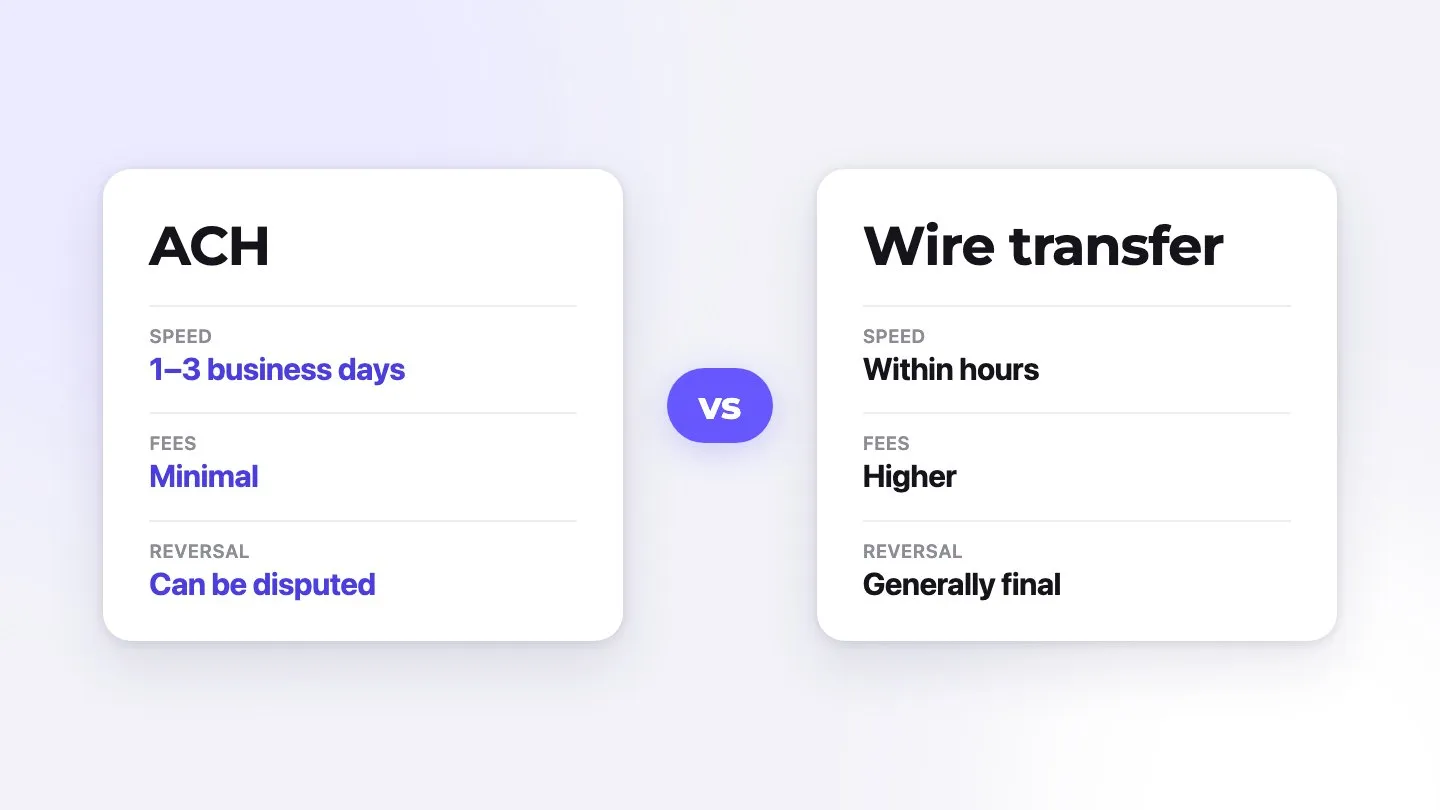
Talking about speed and costs, standard ACH transfers take one to three business days but keep fees minimal. Wire transfers arrive within hours but usually carry a noticeably higher per-transfer fee. The choice isn’t always clear cut.
Choosing the right method makes a real difference to your bottom line.
Whether you’re handling regular payroll, paying vendors, or closing real estate deals, understanding the true costs and speed differences between ACH and wire transfers saves both time and money. Let’s explore these essential transfer methods to help you make smarter choices for your specific needs.
Understanding ACH and Wire Basics
Our banking system moves money through two primary methods: ACH and wire transfers. Experience shows us these methods serve different purposes, each with unique strengths for specific situations.
What is an ACH Transfer?
The Automated Clearing House (ACH) network connects virtually every U.S. bank and credit union account through a batch-based electronic system. It is the workhorse of everyday payments: in December 2025 alone it handled a record 3.22 billion payments.
ACH transfers work in two ways:
- ACH Credits: Money “pushes” from sender accounts, perfect for payroll and government benefits
- ACH Debits: Funds “pull” from accounts, handling your automatic bills and subscriptions
Three key players make ACH work: the ACH Operator (FedACH or Electronic Payments Network), the Originating Depository Financial Institution (ODFI), and the Receiving Depository Financial Institution (RDFI). The system’s success speaks volumes - some 93% of American workers get paid through the ACH Network (Nacha).
How Wire Transfers Work
Wire transfers take a different approach, moving money directly between banks one payment at a time. These transfers pack power - the average Fedwire transfer in 2025 was $5.28 million.
Starting a wire transfer needs specific details - recipient’s name, bank account number, and routing information. Your bank then sends payment instructions through secure networks like Fedwire or SWIFT. The receiving bank puts its own reserve funds into the recipient’s account before settling with your bank.
Value matters more than price here. Wire transfers excel at moving large sums fast, especially for time-sensitive deals like real estate closings or international payments. Most domestic wires complete within 24 hours, though international transfers might need more time based on the destination country.
One key difference stands out - wire transfers rarely allow reversals after completion. This finality makes them perfect for situations where guaranteed payment matters most.
Speed Comparison: ACH vs Wire
Speed makes a vital difference in money transfers. Timing can affect business relationships and bottom lines significantly.
ACH Processing Timeline
Standard ACH transfers need one to three business days to complete. The process runs in batches through the day, with debits typically moving faster than credits. Timing depends heavily on submission windows - those late-day transfers might roll to the next batch. Remember that ACH only processes during business days, pushing weekend or holiday submissions to the next business day.
Wire Transfer Speed
Looking for faster options? Wire transfers outpace standard ACH significantly. These transfers typically clear within minutes and settle within one business day. Your timing options vary based on the system:
- Fedwire: Real-time settlement between U.S. banks
- CHIPS: A private U.S. system for large-value payments that nets transfers between participating banks
- SWIFT: The messaging network behind most international wires; timing depends on the banks involved
Most domestic wires complete the same business day - just meet your bank’s cutoff time, which each bank sets itself, often in the afternoon Eastern Time.
Same-Day Transfer Options
The transfer landscape keeps evolving. The ACH Network now processes payments 23¼ hours every banking day and settles them four times a day. Same Day ACH, launched in 2016, moves payments of up to $1 million within the same banking day (Nacha).
Wire transfers still win the speed race for urgent needs. Your domestic wires can finish within hours, sometimes minutes, depending on receiving bank policies. International wires need more patience, depending on time zones, intermediary banks and compliance checks.
Note that both methods follow banking days. The Federal Reserve’s FedACH service, for example, has three Same Day ACH submission deadlines, the last at 4:45 p.m. ET (FedACH processing schedule); anything submitted later, or on a weekend or holiday, waits for the next processing window.
True Cost Analysis
Money talks when choosing transfer methods. The true cost story goes deeper than basic fees - smart choices come from understanding the complete picture.
Standard ACH Fees
ACH transfers keep costs low. Banks and payment processors usually charge a small flat fee per transfer, and some processors charge a percentage instead. Good news - most banks skip fees for incoming ACH transfers, and many waive charges for standard outgoing ones. Watch for monthly service fees on business accounts though, and check your provider’s current fee schedule.
Wire Transfer Pricing
Wire transfers hit your wallet harder than ACH. Banks set their own wire fees, and they usually follow this pattern:
- Outgoing domestic wires cost more than incoming ones
- Outgoing international wires cost the most
- Incoming wires are cheaper, and some accounts include them for free
- International wires can also carry intermediary bank fees and currency conversion margins
Check your bank’s fee schedule before you choose a method.
Hidden Charges to Watch For
The real costs often hide below the surface. ACH users can face surprise fees like returned-payment or insufficient-funds charges when a debit fails. Same Day ACH service often costs extra too.
Wire transfer costs can sneak up through intermediary banks, especially on international moves. Currency conversion fees pile on more expenses, changing with destination and amount. Some banks even charge investigation fees for tracking or fixing transfers.
Smart banking choices help dodge some fees. Some banks waive incoming wire fees or discount international wires sent in the recipient’s currency, and credit unions often charge less than traditional banks. Compare current fee schedules, since they change.
Security Features and Risks
Security matters more than speed or cost in money transfers. Experience shows us that both ACH and wire transfers need distinct safety approaches to protect your funds.
ACH Security Measures
ACH security builds on layers of protection. The National Automated Clearing House Association (NACHA) sets strict rules for all operators. Your money stays safe through:
- Sensitive data encryption
- Multi-factor authentication (MFA)
- Real-time monitoring
- Dual authorization needs
- Daily limits on transfers
Batch processing helps spot fraud patterns early. Every ACH transfer goes through automated risk checks, flagging anything suspicious for review. High return rates raise red flags - banks watch these closely as signs of unauthorized debits.
Wire Transfer Protection
Wire transfers take a different security path, focusing on verification you can’t undo. Once sent, these transfers stick - no turning back. Banks respond with strict checking procedures, sometimes calling to verify new recipient details.
The stakes run high - the FBI’s Internet Crime Complaint Center recorded $3.05 billion in reported business email compromise (BEC) losses in 2025 alone (IC3 2025 report). Businesses and banks fight back with strict controls:
Two people must handle each step - one starts, another approves. Staff double-check wire details against existing records, never trusting new contact information from current requests. International transfers face extra scrutiny - these moves carry higher risks.
Banks also use automated systems to spot unusual patterns in transfers. Each method brings different safety benefits - ACH lets you fix mistakes within certain windows, while wire transfers lock in right away.
Making the Right Choice
Choosing between ACH and wire transfers comes down to your specific needs. Let’s explore when each method shines brightest.
When to Choose ACH
Experience shows ACH works best for recurring moves and bulk payments. Your business wins with ACH in these cases:
- Regular payroll runs and vendor payments
- Monthly subscription billing
- High-volume, smaller-value moves
- Business-to-business domestic transfers
- Automated bill payments
ACH excels when organizations process payments in batches. Looking for cost savings on multiple transfers? ACH typically costs less when timing flexibility exists. Here’s something exciting - Same-Day ACH now handles up to $1 million, making it a strong choice even for larger amounts.
Best Times for Wire Transfers
Ready to move money fast? Wire transfers shine when immediate settlement matters. Businesses choose wires mainly for:
High-Value Transactions: Need to move big sums? Wire transfers nail it for real estate closings or major business deals. Your money arrives almost instantly when timing matters most.
International Payments: Sending money across borders? Wire transfers speak the global language, and many international partners prefer these established paths.
Urgent Domestic Transfers: Sometimes tomorrow won’t cut it. Sent before your bank’s cutoff, a domestic wire is processed the same day and typically completes within hours.
Large Institutional Moves: Banks trust wires for their biggest transfers. Your business needs this speed when moving thousands of dollars on tight deadlines.
One crucial point - wire transfers stick once sent. Double-check every detail before hitting that send button.
Comparison Table
Ready to see how ACH and wire transfers stack up? This comparison sums up the differences.
| Feature | ACH Transfers | Wire Transfers |
|---|---|---|
| Processing Time | 1-3 business days (standard) Same-day available for payments up to $1 million |
Same business day (domestic) Longer for international wires |
| Domestic Fees | Low; often free to receive | Higher; outgoing wires cost more than incoming |
| International Fees | Mainly a domestic (U.S.) network | Highest; intermediary and currency fees may apply |
| Security Features | • Multi-factor authentication • Encryption • Real-time monitoring • Dual authorization • Batch processing • Dispute windows available |
• Immediate verification • Irreversible transactions • Dual control systems • Callback verification • Enhanced international monitoring |
| Best Used For | • Regular payroll processing • Subscription billing • High-volume, low-value transactions • Automated bill payments • Batch processing |
• High-value transactions • Real estate closings • International payments • Urgent transfers • Large institutional settlements |
| Transaction Limits | Up to $1 million (Same Day ACH); banks may set lower limits | Set by your bank Average Fedwire transfer in 2025: $5.28 million |
| Reversibility | Can be disputed/reversed | Generally cannot be reversed |
| Processing Windows | 23¼ hours on banking days 4 settlement times daily |
Until your bank’s cutoff time |
Value matters more than price here. Each method brings unique strengths to your business. Looking at these numbers, you might wonder which choice fits your needs best. The answer lies in matching these features to your specific situation.
Conclusion
Money moves differently today than it did even five years ago. Successful businesses match transfer methods to specific needs, not the other way around. Standard ACH transfers shine for regular moves like payroll and recurring payments, while wire transfers deliver when speed counts most.
The transfer landscape keeps evolving. Same-Day ACH now handles up to $1 million - a game-changer for businesses that once relied purely on wires. Security grows stronger too, protecting your money through multi-factor checks, encryption, and real-time watching.
Value matters more than price when choosing transfer methods. Smart business owners focus on three key points:
- How fast must the money move?
- What costs make sense for your budget?
- How many transfers do you handle?
Companies moving money in batches save big with ACH’s cost-effective structure. Need guaranteed, instant transfers? Wire transfers cost more but deliver that certainty.
If you bill clients with invoice maker Invoxa, put your bank details for ACH or wire payments in the payment instructions on your invoices and record each payment when it arrives; clients who prefer to pay online can use a card, Apple Pay or Google Pay through your own Stripe account. Remember - success comes from picking the right tool for each job, not forcing one method to handle everything.
FAQs
Q1. What are the main differences between ACH and wire transfers? ACH transfers are typically used for recurring, high-volume transactions and take 1-3 business days to process (or the same day with Same Day ACH). Wire transfers are faster, usually completing the same business day, but are more expensive and best suited for large, time-sensitive transactions.
Q2. How do the costs of ACH and wire transfers compare? ACH transfers usually cost little or nothing per transaction, and incoming ACH payments are often free. Wire transfers carry a higher fee per transfer, outgoing wires cost more than incoming ones, and international wires are the most expensive. Each bank sets its own fees, so check your bank’s current fee schedule.
Q3. Which transfer method is more secure? Both ACH and wire transfers employ robust security measures. ACH uses multi-factor authentication, encryption, and real-time monitoring. Wire transfers focus on immediate verification and irreversibility, with dual control systems and enhanced monitoring for international transfers.
Q4. Can ACH or wire transfers be reversed? ACH transfers can be disputed and potentially reversed within a certain timeframe. Wire transfers, however, are generally irreversible once sent, which is why extra caution is needed when initiating them.
Q5. When should I choose a wire transfer over an ACH transfer? Wire transfers are best for high-value, time-sensitive transactions such as real estate closings, urgent international payments, or large institutional settlements. Choose wire transfers when immediate settlement is crucial and you’re willing to pay higher fees for speed and guaranteed delivery.